Most people would be familiar with the traditional freight train. There’s an engine (the ‘locomotive’ part of a train) pulling a row of trailers, called wagons or rolling stock.
These wagons carry the freight, which is often packed into large rectangular steel containers, often called ‘shipping containers’.
Most freight railway lines in Australia are built so that these trains can only carry one shipping container per wagon.
Trains using the Inland Rail line will be able to carry more freight, as the line will be able to accommodate double-stacked trains.
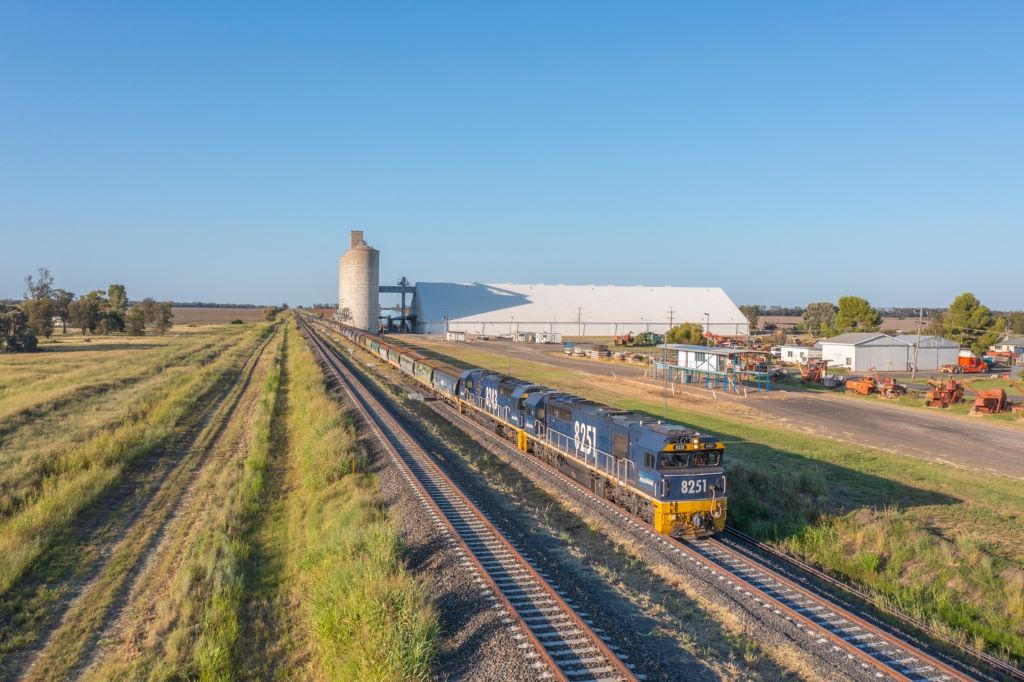
What are double-stacked freight trains?
Inland Rail is being built to allow for the operation of ‘double-stacked trains’, which are specially designed trains capable of carrying two layers of shipping containers on a single wagon.
Using double-stacked trains means that more goods can be moved in one trip, using the same rail line.
As displayed in the interactive model (below), a double-stacked freight train carries shipping containers in two layers on specially designed wagons, called well wagons.
Well wagons allow containers to be carried lower than a traditional flat wagon, reducing vertical clearance and the wagon’s centre of gravity.
A single-stacked train carries containers in one level, usually on a flat wagon.
What does accommodating double-stacked trains mean for the design and construction of Inland Rail?
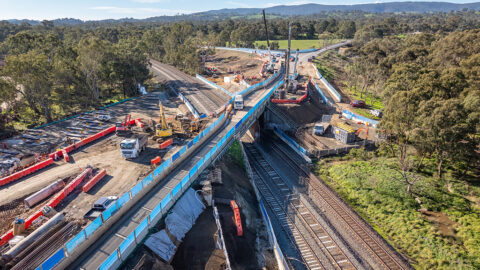
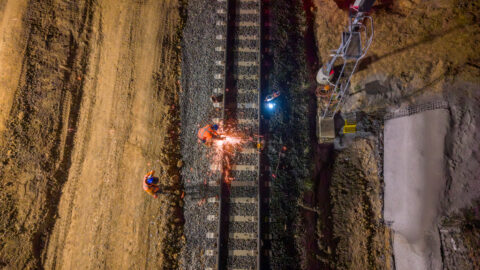
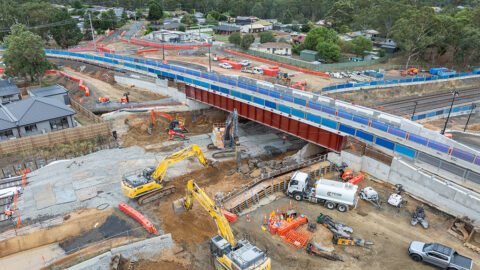
The majority of Inland Rail’s work is to upgrade or enhance existing railway corridors so that the taller double-stacked trains have enough ‘clearance’ (room around the train and tracks) to allow them to run safely on the tracks. As well as upgrading the actual railway tracks, the infrastructure in the corridor – such as bridges crossing over the line or structures close to the tracks – also need to be adjusted.
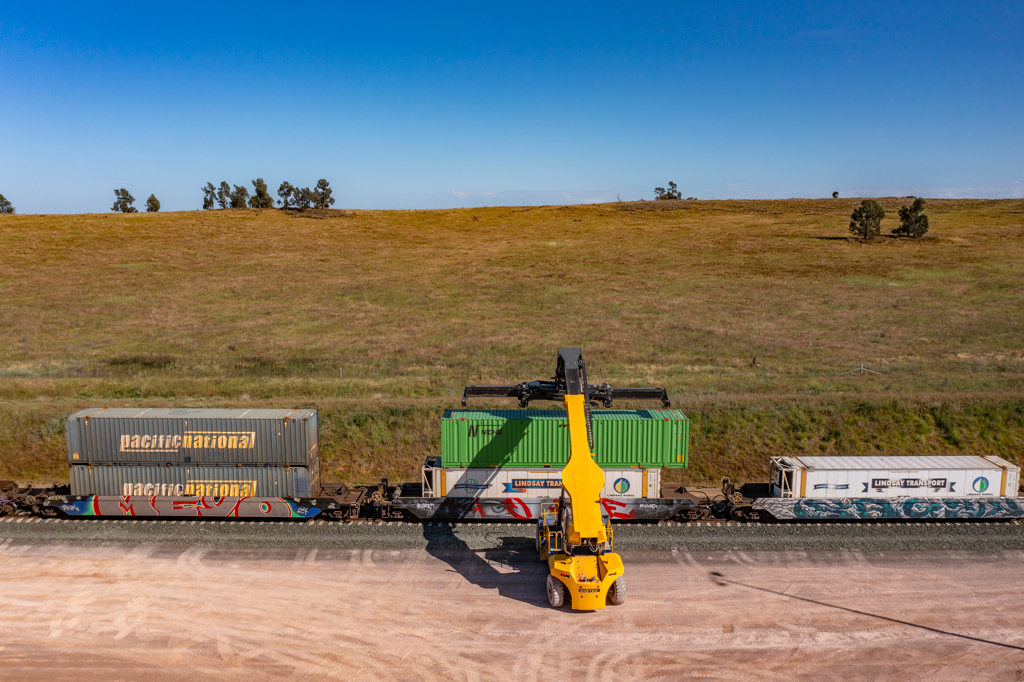
Loading a second layer of shipping containers onto a train.
Australia’s rail network was built at different times throughout its history, and to different standards. For example, there are three different gauges (widths) of tracks in use across Queensland, New South Wales and Victoria, which means certain trains can only run on certain tracks. Rail corridor widths also differ due to the different standards in each state.
Double-stacked freight trains began operating in Australia in the late 1980s. However, much of Australia’s rail network was built long before double-stacked trains were introduced and therefore doesn’t have the necessary clearance or capacity for the taller and heavier double-stacked trains.
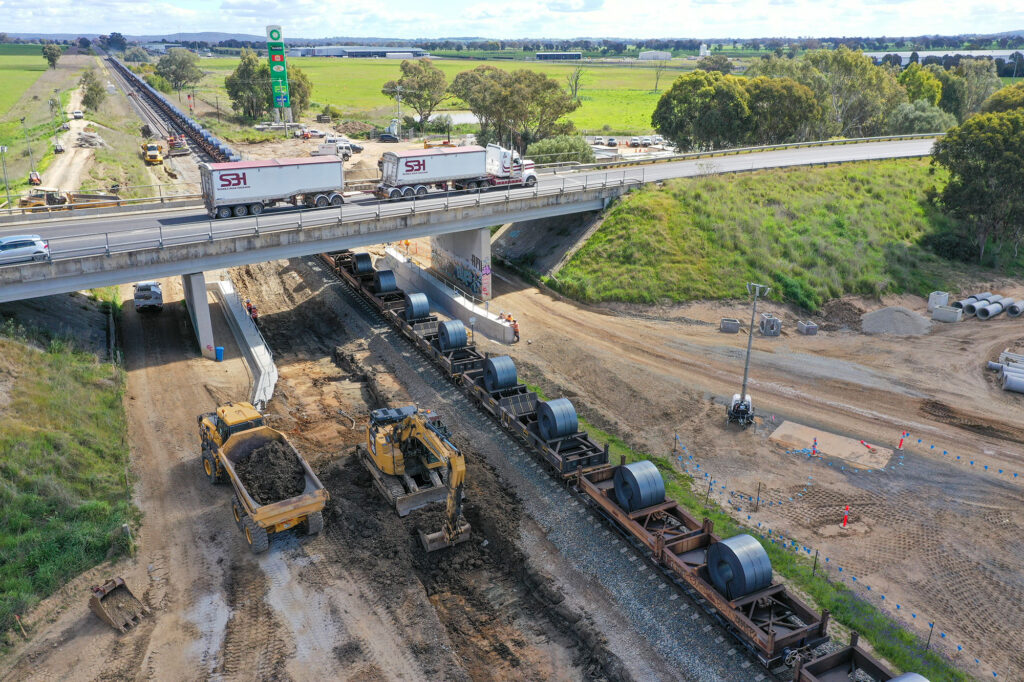
Freight train passing during Inland Rail works in 2023 at Murray Valley Highway site, Barnawartha North. Major construction to lower the rail tracks under the road bridge is now complete.
Some of the existing alignment is already capable of carrying the weight of double-stacked trains. But where it is not, Inland Rail is being designed to feature 7.1 m clearances for double-stacked train operation, which is the ‘room’ required for the taller train to pass safely under bridges, through tunnels and past platforms and other structures.
For example, our work in Glenrowan, Victoria, replaced a 60-year-old road bridge with a new, higher structure to allow sufficient clearance for double-stacked freight trains to pass safely underneath it (as shown in the below video).
Why double-stacking increases Australia’s freight capacity
Inland Rail is progressively being delivered in sections to provide early access to increased rail freight capacity with double-stacked trains. Inland Rail is already improving freight connections with Adelaide and Perth via the now-operational North-West Connection at Parkes.
When the prioritised sections are operational, increased rail freight capacity will be available between Beveridge, Victoria and Parkes, NSW. This will also enable double-stacked trains to access existing ARTC freight network connections to Perth, Adelaide and the East Coast.
Not every train using the Inland Rail line will need the maximum 1,800m length, or full double-stacked capacity, straight away. Demand is expected to build over time.
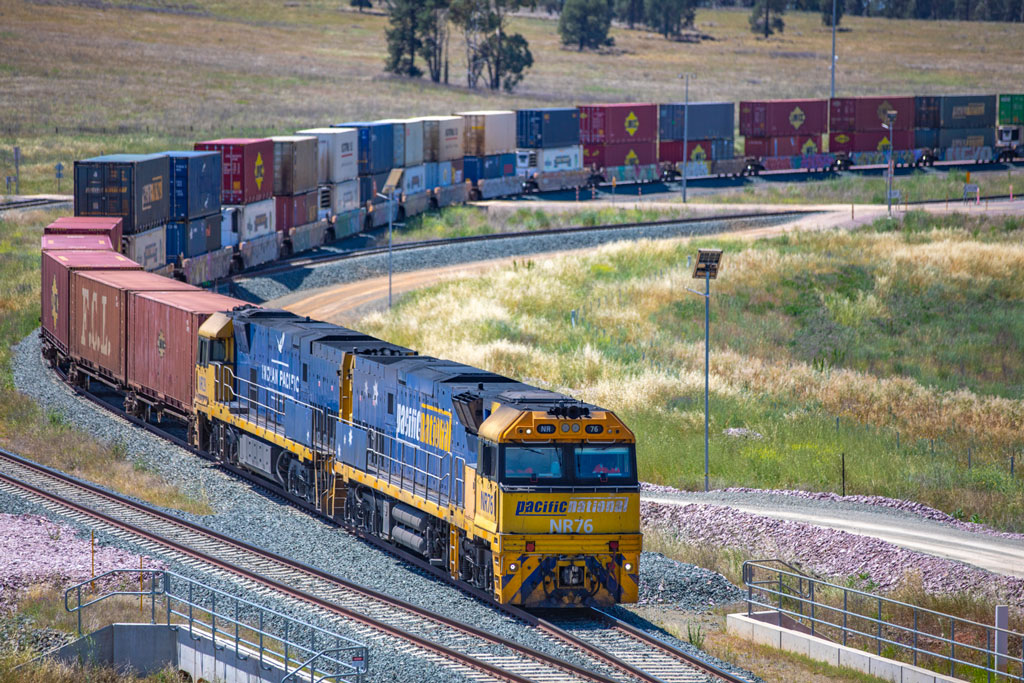
A double-stacked freight train.