Inland Rail’s vision is to eventually create a 1,600km fast freight rail line designed to connect Melbourne and Brisbane through regional Victoria, New South Wales, and Queensland, enabling efficient double-stacked container freight transit.
Inland Rail involves enhancing existing railway track and surrounding infrastructure, as well as constructing new track, to enable ‘double-stacked’ trains to use the line.
Inland Rail is on track to complete construction of sections between Beveridge, Victoria and Parkes, NSW as a priority.
This will increase rail freight capacity and enable double-stacked trains to access existing ARTC freight network connections to Perth, Adelaide and the East Coast.
The Inland Rail program is being delivered by Inland Rail Pty Ltd, a subsidiary of the railway operator Australian Rail Track Corporation (ARTC), on behalf of the Australian Government.
The purpose of Inland Rail
Inland Rail is intended to help Australia keep pace with increasing freight demand through a more resilient and future-proofed freight network.
It is an important project to support Australia’s growing freight task, improve road safety and help decarbonise our economy.
Inland Rail will enhance our national freight and supply chain capabilities, connecting existing freight routes and supporting Australia’s growth.
As each of its sections is completed, Inland Rail will better link businesses, manufacturers and producers to national and global markets and generate opportunities for industries and regions during construction and beyond.
Delivering Inland Rail will help shift more everyday goods onto rail, meaning faster, more resilient freight; safer, less congested roads; and fewer emissions.
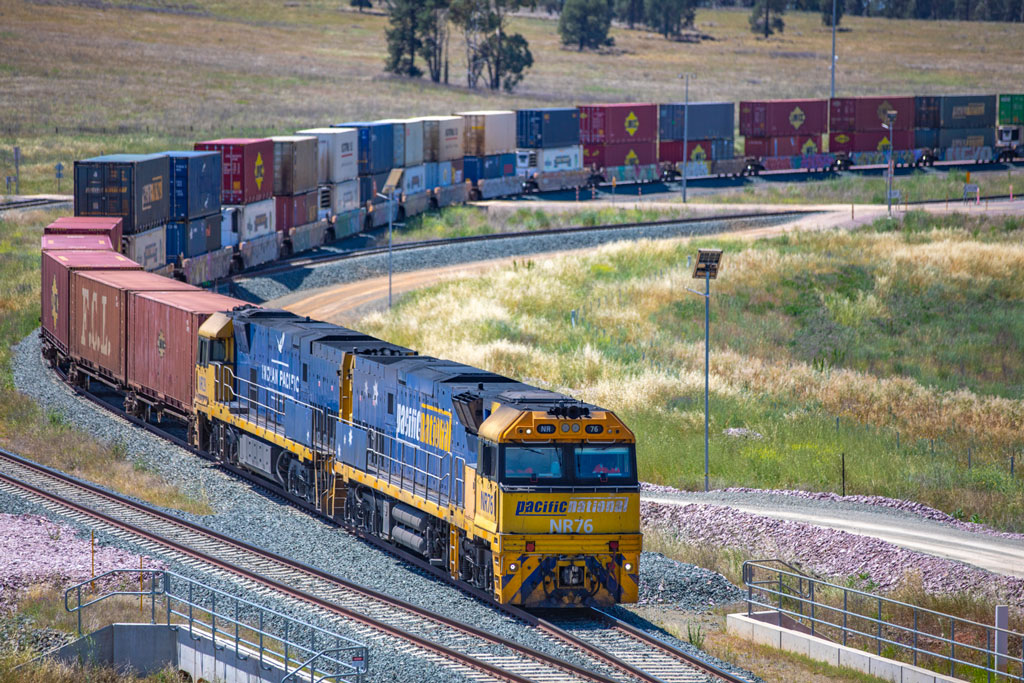
Benefits are already being delivered
Construction between Beveridge, Victoria and Parkes, NSW remains on track to be completed as a priority. This will increase rail freight capacity between Beveridge and Parkes, enabling double-stacked trains to access existing ARTC freight network connections to Perth, Adelaide and the East Coast.
Community benefits during construction
As at 31 March 2026, Inland Rail construction in New South Wales and Victoria has:
- generated more than 9,847 jobs for local and First Nations people
- injected more than $771 million into regional economies
- engaged 1,262 local businesses in supplying goods and services
- spent more than $708.6 million with local businesses.
Why Inland Rail matters
Faster, more resilient freight
Inland Rail is intended to help Australia keep pace with increasing freight demand through a fast, safe, resilient and efficient freight network.
Supporting Australia’s growing freight task
Australia’s population is projected to reach between 37.4 and 49.2 million people by 2066. Inland Rail will help meet growing freight demand while reducing pressure on the road network.
Better access to markets
Inland Rail will better link businesses, manufacturers and producers to national and global markets.
Safer roads and lower emissions
Inland Rail has the potential to reduce traffic congestion, improve road safety and reduce carbon emissions by shifting more freight from road to rail. Moving freight by rail is 16 times more fuel efficient than moving freight by road.
How Inland Rail will be used
Inland Rail has been designed so that trains capable of carrying more freight can use the line, including double-stacked freight trains.
As each section is completed, it is commissioned by the railway operator, ARTC.
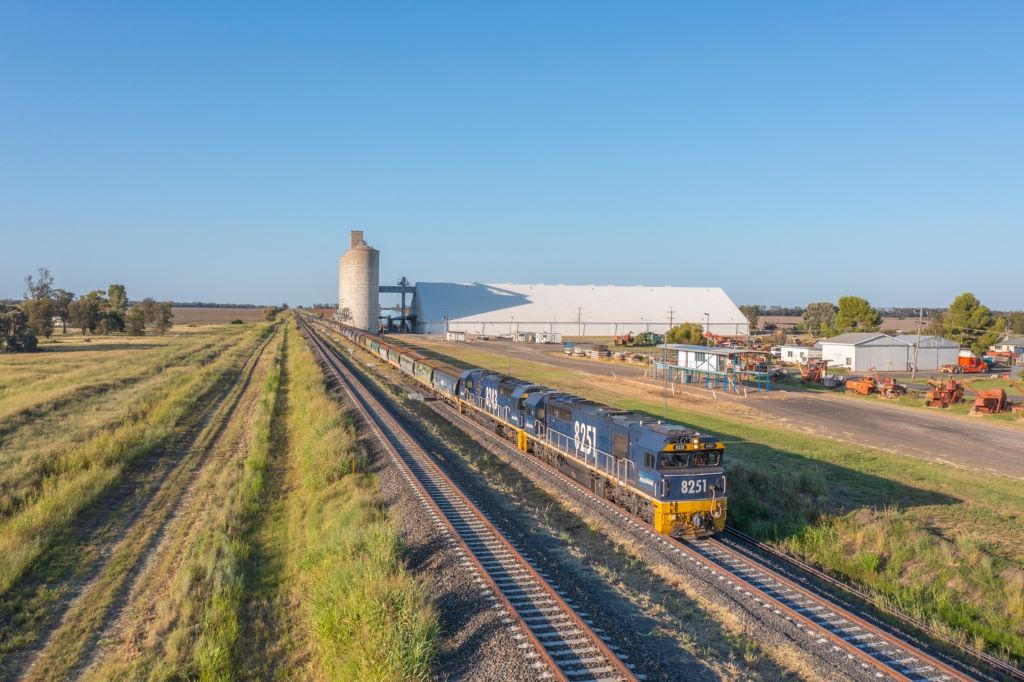
GrainCorp grain train on Narrabri to North Star line.
Now:
Trains are already running on the completed sections of Inland Rail.
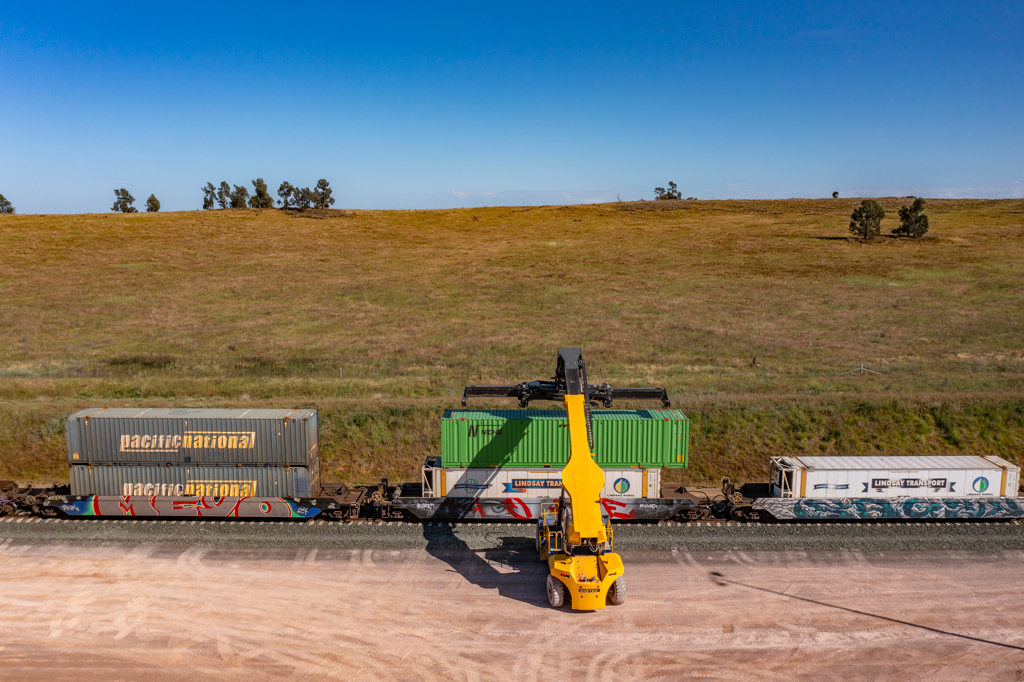
Loading a second layer of shipping containers onto a train.
When Beveridge to Parkes is complete:
Double-stacked freight trains using the completed Inland Rail sections will be able to access existing ARTC freight network connections to Perth, Adelaide and the East Coast.
Vision for the full route:
The vision for Inland Rail’s full 1,600km route is to create a double-stacked service offering between an intermodal terminal at Beveridge in Victoria and a proposed intermodal terminal at Ebenezer in Queensland.
Single-stacked trains will operate beyond Ebenezer to Kagaru, connecting to the existing Sydney to Brisbane coastal line and broader freight networks.
About two-thirds of the freight ultimately carried on a fully completed Inland Rail will be for domestic use, including household goods and food.
Who is building Inland Rail?
Inland Rail Pty Ltd, a subsidiary of Australian Rail Track Corporation (ARTC), is building Inland Rail on behalf of the Australian Government.
We’re partnering with regional businesses and communities to make it happen.
As each section of Inland Rail is completed, it will be operated and managed by ARTC.
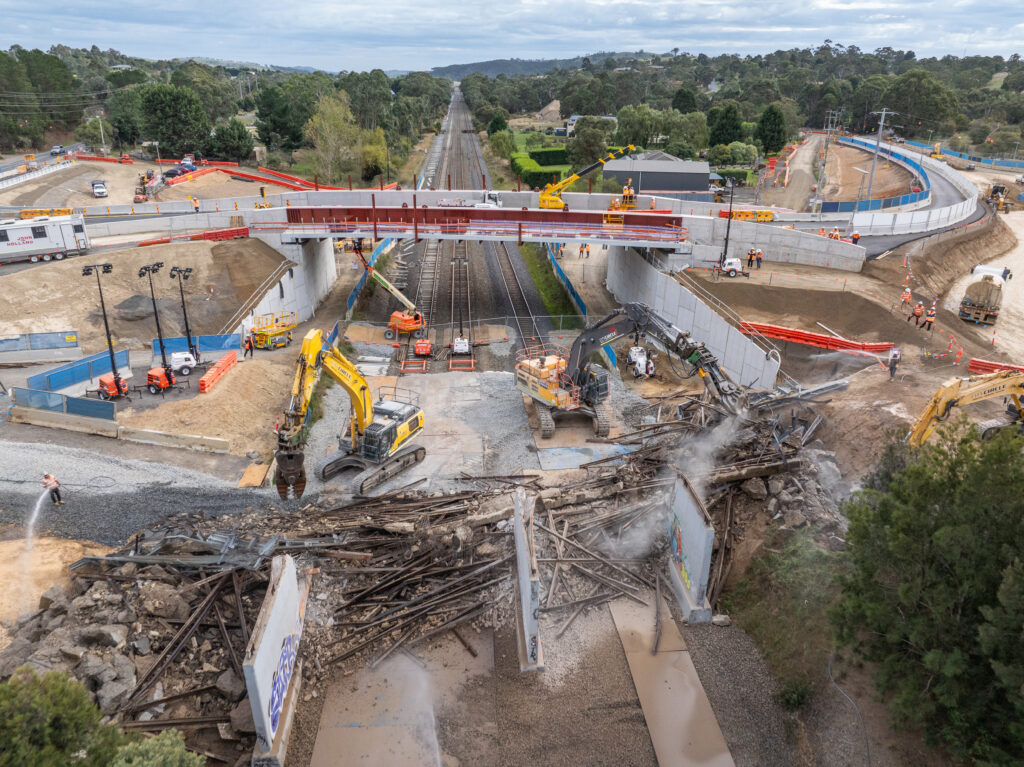
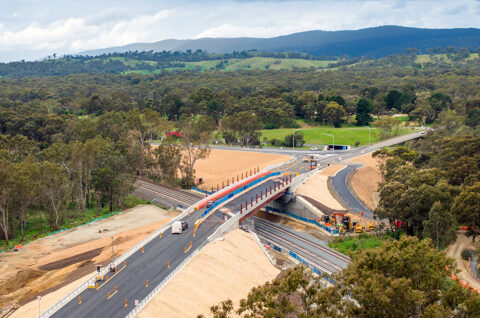
Construction at Wandong, May 2026.
Status of the Inland Rail project
Construction of the Inland Rail route between Beveridge, in Victoria, and Parkes, in NSW, is prioritised for completion.
Some sections are already completed, with trains running on the line.
The Australian Government has confirmed that construction between Beveridge and Parkes remains the priority. Works north of Parkes will focus on preserving the rail corridor.
Inland Rail is working with ARTC and the Australian and state governments to determine what is required to preserve the corridor.
What are the Inland Rail Sections?
There are 12 Inland Rail sections across three Australian states. Click on the state name to find out more.
Construction is underway in Victoria and is prioritised for completion. Subscribe for updates.
Beveridge to Albury
Comprises 262km of existing track.
This section will be enhanced to increase height and width clearances to allow for double-stacked trains.
In New South Wales, the section from Parkes to Narromine is operational and major construction on the Narrabri to North Star Phase 1 section is completed. The NSW project areas south of Parkes are prioritised for completion by the end of 2027. Subscribe for updates.
Albury to Illabo
Comprises 185km of existing track.
Enhancements or modification works are being undertaken at various locations including Junee, Wagga Wagga and Albury to allow for safe clearance of double-stacked freight trains.
Illabo to Stockinbingal
Comprises 39km of new track and 3km of upgraded track.
The route bypasses the winding section of track called the Bethungra Spiral.
Stockinbingal to Parkes
Comprises 170km of existing track. Construction on this section was completed in early 2026.
The sections of the Inland Rail route to be preserved for future optionality include:
Parkes to Narromine
Comprises 98km of existing track and 5km of new track.
This was the first section of Inland Rail to be completed and is operational with double-stacked trains.
Narromine to Narrabri
Comprises 306km of new rail corridor and track.
This new section will reduce the overall journey time and complete one of the missing rail links between Melbourne, Adelaide, Perth and Brisbane.
Narrabri to North Star
Comprises 184km of upgraded track and 2km of new track.
This section is divided into Phase 1 and Phase 2. Major construction on Phase 1 is complete. Phase 2 is in the environmental approvals phase.
North Star to NSW/Qld Border
Comprises 5km of new track and 25km of existing track.
This section will complete one of the key missing rail links between New South Wales and Queensland, using the non-operational rail corridor or new track to connect to the operating line running to Yelarbon.
The sections of the Inland Rail route to be preserved for future optionality include:
NSW/Qld Border to Gowrie
Comprises 217km of dedicated single track featuring approximately 149km of new rail corridor and 68km of existing open access rail corridor.
Gowrie to Helidon
Comprises 28km of new dual gauge track.
This section will traverse the steep terrain of the Toowoomba Range and will include a 6.2km tunnel.
Helidon to Calvert
Comprises 28km of new dual gauge track.
This section will cross the Lockyer Valley floodplain and the Little Liverpool Range with an 850m tunnel.
Calvert to Kagaru
Comprises 53km of new dual gauge track within existing rail corridor.
This section includes 39km of dual-gauge track allowing single-stacked operations between a proposed terminal at Ebenezer and Kagaru.
Using 1.1km of tunnelling, this section will connect Inland Rail with the existing Sydney to Brisbane coastal line and the Port of Brisbane.
Inland Rail frequently asked questions
Some sections of Inland Rail are already completed and operational.
Construction between Beveridge in Victoria and Parkes in NSW is on track for completion.
In May 2026, the Australian Government confirmed that Inland Rail will be delivered between Beveridge and Parkes by the end of 2027 enabling double stacked freight trains to travel between Melbourne, Perth and Adelaide, via Parkes.
The Government also confirmed that it will work with the Queensland and New South Wales Governments to preserve the rail corridor north of Parkes to allow for future project delivery.
Learn more about Inland Rail’s progress:
The Stockinbingal to Parkes, Parkes to Narromine and Narrabri to North Star Phase 1 sections in NSW and four Beveridge to Albury Tranche 1 sites in Victoria are completed and trains are running.
Learn more about Inland Rail’s progress:
The Australian Government is providing funding for the construction of Inland Rail.
Inland Rail Pty Ltd, a subsidiary of Australian Rail Track Corporation (ARTC) is building Inland Rail, on behalf of the Australian Government.
ARTC operates and maintains the nation’s freight network on behalf of the Australian Government.
When a section of the Inland Rail line is finished, Inland Rail Pty Ltd ‘commissions’ (hands over) that section to ARTC so it can be used by freight operators.
Learn more about ARTC:
The decision to run passenger services on the Inland Rail line is a matter for each State Government along the alignment, or for private operators, to determine in the future.
Inland Rail Pty Ltd has been commissioned by the Australian Government to design and construct Inland Rail primarily for double-stacked freight trains.